The first year of a baby’s life is filled with remarkable milestones. Between 6 and 12 months, babies learn to sit independently, crawl, grasp objects, recognize familiar faces, and explore the world through touch, sound, and movement. During this exciting stage, the right toys can do much more than entertain—they can encourage healthy development, strengthen essential skills, and create joyful learning experiences.
Parents often wonder which toys are truly beneficial and which are simply marketing gimmicks. The best toys for babies 6-12 months old combine fun, safety, and developmental value. They encourage curiosity, build confidence, and support important milestones without overwhelming a baby’s growing mind.
This guide explores the most effective toys for babies between 6 and 12 months and explains how each type contributes to learning and development.
Why Toys Matter During the 6-12 Month Stage
At this age, babies experience rapid brain development. Every interaction helps create neural connections that support future learning.
Developmental toys can help improve:
- Fine motor skills
- Hand-eye coordination
- Sensory awareness
- Problem-solving abilities
- Early language development
- Social and emotional growth
- Cause-and-effect understanding
Rather than focusing on flashy features, parents should choose toys that encourage exploration and active engagement.
Key Developmental Milestones Between 6 and 12 Months
Understanding developmental milestones can help parents select age-appropriate toys.
| Age Range | Common Milestones |
| 6-7 Months | Sitting independently, reaching for objects |
| 7-8 Months | Improved grasping skills, object exploration |
| 8-9 Months | Crawling, recognizing familiar people |
| 9-10 Months | Pulling up to stand, imitating sounds |
| 10-11 Months | Improved coordination, object permanence |
| 11-12 Months | First words, cruising along furniture |
The best toys support these natural stages of development.
Best Types of Toys for Babies 6-12 Months
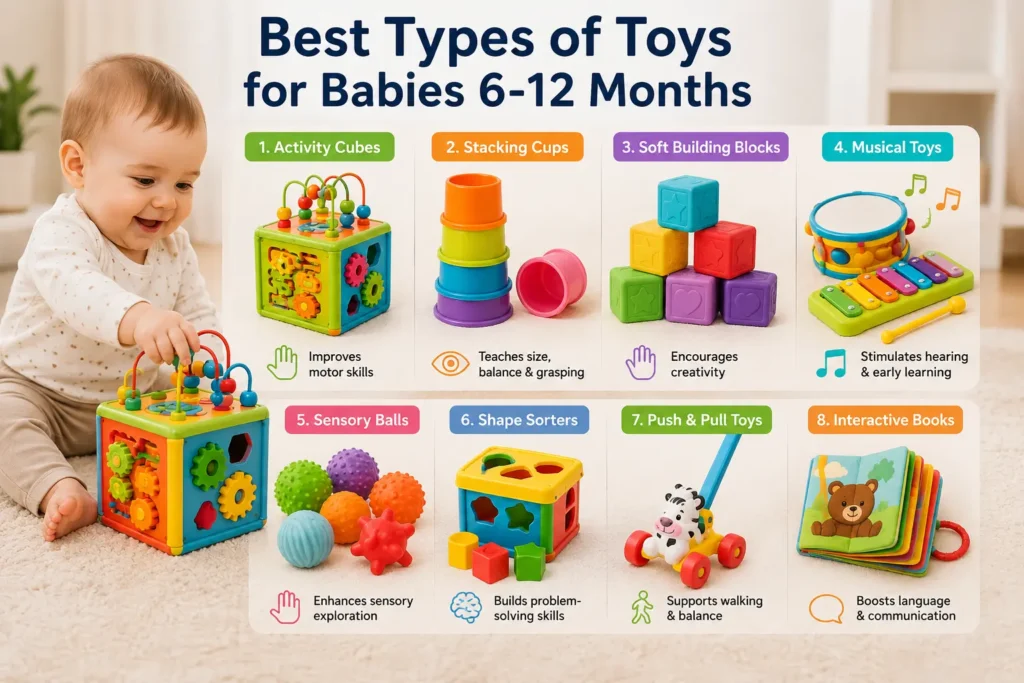
1. Activity Cubes
Activity cubes offer multiple learning experiences in one toy.
Features often include:
- Spinning gears
- Sliding beads
- Shape sorters
- Mirrors
- Interactive panels
Benefits:
- Improves hand-eye coordination
- Encourages problem-solving
- Develops fine motor skills
- Promotes independent exploration
These toys can keep babies engaged for longer periods while supporting cognitive development.
2. Stacking Cups
Stacking cups may seem simple, but they provide valuable learning opportunities.
Babies can:
- Stack them
- Knock them down
- Nest them together
- Fill them with objects
Developmental Benefits:
- Understanding size relationships
- Fine motor development
- Cause-and-effect learning
- Early problem-solving skills
Many parents are surprised by how often babies return to this classic toy.
3. Soft Building Blocks
Soft blocks are excellent for babies who are still exploring objects with their mouths.
Advantages include:
- Safe design
- Lightweight materials
- Bright colors
- Various textures
Skills Developed:
- Sensory exploration
- Hand coordination
- Early construction concepts
- Visual tracking
Soft blocks also encourage imaginative play as children grow older.
4. Musical Toys
Music stimulates multiple areas of the brain simultaneously.
Popular options include:
- Baby drums
- Musical keyboards
- Interactive song toys
- Rattles with musical elements
Benefits:
- Auditory development
- Rhythm recognition
- Memory enhancement
- Language development support
Babies often learn cause and effect by pressing buttons that produce sounds.
5. Sensory Balls
Sensory balls come in different shapes, textures, and colors.
Why babies love them:
- Easy to grasp
- Interesting textures
- Encourages crawling
- Supports tactile learning
Developmental Benefits:
- Strengthens hand muscles
- Improves coordination
- Enhances sensory processing
- Encourages movement
These toys are especially useful during active crawling stages.
6. Shape Sorters
Shape sorters introduce early problem-solving skills.
Babies begin learning:
- Shape recognition
- Spatial awareness
- Matching concepts
- Logical thinking
Although younger babies may need assistance, exposure to shape sorting lays the foundation for future cognitive skills.
7. Push-and-Pull Toys
As babies begin standing and taking early steps, push toys become increasingly valuable.
Benefits include:
- Improved balance
- Strengthened leg muscles
- Walking confidence
- Gross motor development
Parents should choose sturdy models designed specifically for beginner walkers.
8. Interactive Books
Books are among the most powerful educational tools available.
Look for:
- Cloth books
- Board books
- Touch-and-feel books
- Lift-the-flap books
Benefits:
- Language development
- Vocabulary growth
- Attention skills
- Parent-child bonding
Daily reading routines can significantly support future literacy skills.
Features to Look for When Choosing Baby Toys
Not every toy marketed for babies provides meaningful developmental value.
Consider these factors:
Safety
Choose toys that are:
- BPA-free
- Non-toxic
- Free from small detachable parts
- Durable and easy to clean
Age Appropriateness
Always follow manufacturer age recommendations.
Open-Ended Play
The best toys allow babies to explore in multiple ways rather than requiring one specific action.
Sensory Engagement
Look for toys that stimulate:
- Touch
- Sight
- Sound
- Movement
Balanced sensory experiences support healthy development.
Common Toy Buying Mistakes Parents Make
Buying Too Many Electronic Toys
Lights and sounds can be entertaining, but excessive electronic stimulation may reduce opportunities for creative exploration.
Ignoring Developmental Goals
A toy should match a baby’s current developmental stage rather than simply being popular.
Choosing Toys Based Solely on Trends
Some of the most beneficial toys are simple classics that have supported childhood development for generations.
Overlooking Safety Standards
Always prioritize safety certifications and reputable manufacturers.
Expert Tips for Maximizing Learning Through Play
Parents can enhance learning by actively participating in playtime.
Try these strategies:
- Narrate actions during play.
- Introduce new words frequently.
- Encourage exploration without constant correction.
- Rotate toys weekly to maintain interest.
- Celebrate effort rather than performance.
Interactive play helps babies develop confidence and stronger communication skills.
Final Thoughts
Choosing the best toys for babies 6-12 months is about more than keeping them entertained. The right toys create opportunities for discovery, movement, communication, and learning. During this critical stage of development, every interaction contributes to a child’s growing understanding of the world.
Simple toys such as stacking cups, sensory balls, books, and activity cubes often provide the greatest developmental benefits. By focusing on safety, age appropriateness, and educational value, parents can create enriching play experiences that support lifelong learning and healthy development.
The most meaningful toy, however, is often an engaged caregiver who plays, talks, reads, and explores alongside their baby. Together, these experiences build the foundation for future success, curiosity, and confidence.
Frequently Asked Questions
Activity cubes, stacking cups, sensory balls, soft blocks, shape sorters, and interactive books are among the most beneficial educational toys.
No. Many child development experts recommend balancing electronic toys with simple open-ended toys that encourage creativity and exploration.
Quality matters more than quantity. A small collection of well-chosen toys can provide excellent developmental benefits.
Yes. Interactive books, musical toys, and parent-guided play can significantly support early language skills.
Absolutely. Sensory toys help babies explore textures, sounds, colors, and movement while supporting brain development.